Showing posts with label Temple tanks. Show all posts

Sunday, November 11, 2018

Pithapuram: The divine abode - Puruhootika Devi temple


By Aruna Ravikumar | THE HANS INDIA |   Nov 11,2018 , 12:55 AM IST
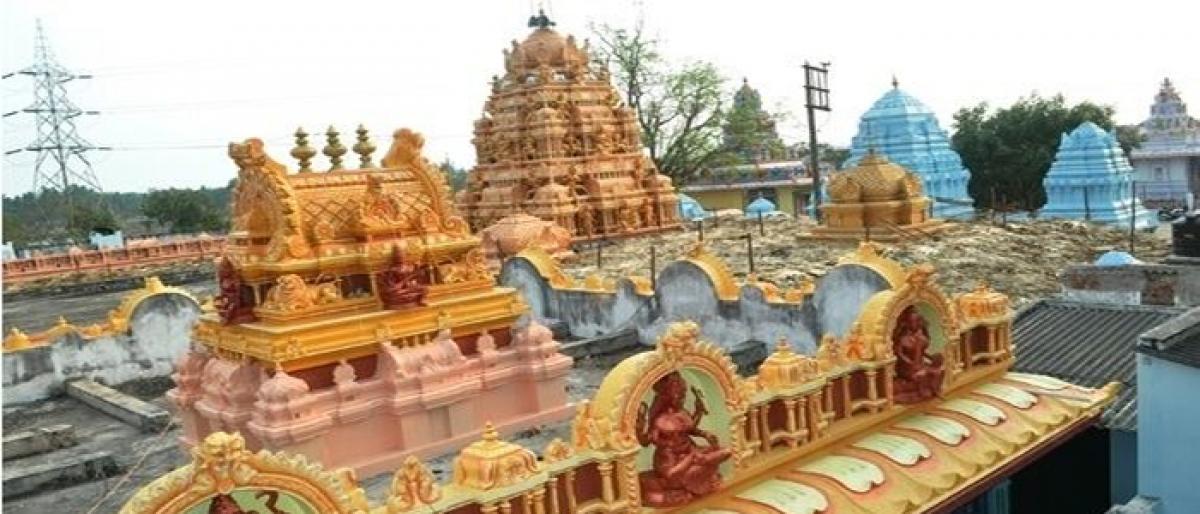
Puruhootika Devi temple

It is not just scenes from the epics and Puranas etched on stone and the architectural splendour that holds your attention. The splash of colour embellishing different sculptures within and outside the temple complex stand out in stark contrast to the light-coloured walls and the gopuram or the main entrance.

Birds delicately perched on the branches of the sacred Audambara tree add to the allure as does the pushkarini (pond) at the entrance. The huge temple complex of ‘‘Kukkuteshwara Swamy” in Pithapuram in the East Godavari district of Andhra Pradesh said to be one of the oldest and most sacred pilgrimage centres in India has a distinctly different feel to it. It beckons not just the devout but those interested in history, folklore and architecture.

With the history of the region dating back to the 5th century, architecture is said to be influenced by the style of the Vishnukundin and Chalukya dynasties. Referred to as “Pithikapuram” in the Puranas it is one of the Ashta dasha (18) Shakti peethas or places where body parts of Goddess Sati Devi fell. Driving down from Kakinada, on the wide well-maintained road with the sparse morning traffic, we found ourselves inside the temple well ahead of the half an hour travel time mentioned by the locals. The temple referred to as “Dakshina Gaya” or “Pada Gaya” is of three-fold importance as a Shiva Kshetra, a Shakti peetham and the birthplace of Sripada Vallabha one of the first incarnations of Lord Dattatreya.

As soon as we enter the temple, we see the mandapam housing the huge horizontal statue of Gayasura, a powerful and pious asura on whose body Brahma, Vishnu and Maheshwara are performing a yagna. His body was said to be so huge that his head rested in Bihar, body in Orissa and feet touched Pithapuram. Legend has it that Gayasura, who had become all-powerful had usurped Indra’s position as the King of the God’s and the trinity approached Gayasura disguised as Brahmins in response to Indra’s penance.

They asked Gayasura for a place to perform the Yagna upon which Gayasura offered his body as a venue. The Gods agreed on the condition that they would slay him if he got up before the completion of the yagna. Gayasura was tricked into believing that the yagna was completed on the 7th day when he heard a rooster crow at “midnight” and was slain.

This is where Gayasuras feet fell and is known as “Pada Gaya”, where visiting devotees are said to gain moksha or liberation. Kukkuteswara Swamy, a form of Lord Shiva is the presiding deity, who reveals himself in the form a swayambhu (self-originating) marble lingam of two-feet height, resembling a “kukkutam” (rooster). Facing Kukkteshwara Swamy is a huge “Eka Sila Nandi” (bull) carved out of a single stone.

To the Northeast corner of the temple is the black stone idol of Goddess “Puruhootika Devi” with the temple walls carved with the 18 incarnations of the goddess. The idols of “Hoonkarini Devi” and “Raja Rajeshwari’’ are among the several smaller shrines to various gods and goddesses that are nestled inside. Behind these shrines is the “Sripada Vallabha” kshetra, the incarnation of Dattatreya and the Audamabar tree where devotees pray with fervour for fulfilling their wishes. 

Source: https://www.thehansindia.com/posts/index/Sunday-Hans/2018-11-11/Pithapuram-The-divine-abode/440116

Monday, June 13, 2011

Temple tanks need help


R.Srikanth and Lavanya.M
Sewage inflow, dumping of waste major issues, says report
CHENNAI: All 34 temple tanks in the city and surrounding areas require renovation work of some kind, as per a status report prepared by the Hindu Religious and Charitable Endowment Department (HR and CE).
While some of the tanks remain dry in summer, the biggest problem faced in the maintenance of these tanks, according to the report prepared by the department is the dumping of waste and letting of sewage. The present state is due to lack of awareness among public about the crucial role played by these tanks, an official says.
The purpose of temple tanks is not confined to celebrating float festivals. They serve the larger purpose of recharging groundwater. “These tanks have the ability to recharge the surrounding area within a radius of about 500 metres,” says Madhavi Ganesan, associate professor, Centre for Water Resources, Anna University.
“Temple tanks in the city are a mechanism for harvesting rainwater. In a city that receives an annual rainfall of close to 1,200 mm, these tanks can be optimally utilised. The rainwater that falls in the temple and the surrounding areas can be diverted into the tank, and this will help satisfy most of the water requirements,” she says.
Coordinated effort
“The renovation of temple tanks involves a coordinated job. Only with the help of the Chennai Corporation and the Chennai Metrowater, the tanks can be safeguarded,” says an official from HR and CE.
The inlets system of certain tanks is also not well planned as many have been blocked in the face of urbanisation.
“The Marundeeswarar temple tank in Thiruvanmiyur has a stormwater drain directed to the temple without any treatment facility. The tank is now half full of putrid water,” says Sreedhar Subramanian, a member of Valmiki Nagar Residents' Welfare Association.
“Another issue is the clay bed laid as a result of which the temple tank does not seem to act as a percolation tank,” he adds.
Voluntary organisations
But, some of the community members have woken up to the importance of rainwater harvesting and come forward to improve the situation.
The residents near the Arkeeswarar temple in Pammal, pooled in money and with assistance from certain voluntary organisations restored the tank to its original state.
“We have ensured that rainwater that falls in the surrounding areas of the tank is first directed into a smaller tank where the sediments settle down, after which it flows into the temple tank. Before the project, the tank was filthy, but now it is clean and regularly maintained by the authorities. The biggest advantage has been that the water level in wells in the surrounding areas has improved considerably,” says S. Indra Kumar, a resident of Pammal.

Thursday, October 17, 2002

Temple tanks in Tamil Nadu to harvest rainwater


Even as Tamil Nadu demands much-needed water from neighbouring Karnataka, people in this state are renovating disused water tanks in temples in an effort to conserve the precious resource

The coastal landscape of Tamil Nadu is dotted with temples. Around 4,000 temples traditionally had water tanks that were used for various rituals. The tanks also served as natural aquifers and helped recharge groundwater.

Over the years, however, many of these tanks have gone out of use. Overflowing mounds of silt and garbage have replaced the water in them.

Now, following sustained campaigns by voluntary organisations and departments in charge of water distribution and use, authorities in Chennai have decided to restore around 40 major temple tanks in the city. The aim is to convert the tanks into catchments for rainwater harvesting.

Hindu religious and charitable endowments in charge of the temples have begun a clean-up act in some major temples and called for tenders to repair the tanks.

The drive began with the Parthasarathy and Kapaleewswar temples. In Tiruchirapally, a tank at the Rockfort temple is also being kept clean.

Municipality authorities and the water department have initiated projects to de-silt tanks with the help of volunteers from the community.

The roads and highways department too has got into the act, studying the feasibility of diverting rainwater from storm-water drains on state and national highways and major road networks into the temple tanks.

In the case of the Marundeeswara temple, a 10th century Siva temple in Thiruvanmiyur, the Indian National Trust for Art and Cultural Heritage (INTACH) and the Rotary Club are working to revive the tanks, which are now completely dry.

The Rotary Club first renovated the tanks 10 years ago, but because of the lack of maintenance they soon turned into garbage dumps for a vegetable market nearby.

INTACH has even produced a short film on its efforts so far and is showing it free to local communities. The film records the memories of local residents, some of whom say that until the 1970s one could even fish in the temple tanks.

“The film is the first step in our community awareness programme,” says P T Krishnan, an INTACH official.

“The implementation of the rainwater harvesting scheme will automatically raise the tank water level and recharge groundwater in the area,” Krishnan adds.

Chennai corporation chief engineer M Bhoopal and deputy mayor Karate Thyagarajan are overseeing the clean-up operation at the Marundeeswara temple.

“At least four other temple tanks, including the Parthasarathy temple tank, are being cleaned for rainwater harvesting,” says Bhoopal.

The Marundeeswara temple is a test site. Every Saturday and Sunday, for several weeks now, dozens of volunteers armed with shovels descend into the 1,60,000-square-foot tank and work to clean it for four-five hours.

“Soon the surplus flow will be able to meet the needs of this water-starved but densely populated region,” says Bhoopal.

Another voluntary organisation, Pasumai Thayagam, or Green Motherland, is also initiating efforts to restore temple tanks and adopt an integrated approach to water management.

The group has taken up the task of restoring and rehabilitating around 1,000 tanks and ponds throughout the state, with help from the community.

“It is critical to protect conventional water resources like tanks and ponds for sustainable development, and stop surface water run-off into the sea, through the development of micro watersheds and check-dams,” says coordinator R Anbumani.

Pasumai Thayagam showcased its efforts at the World Summit on Sustainable Development in Johannesburg in September and received an enthusiastic response.

Source: [I]The Times of India, [/I]October 17, 2002